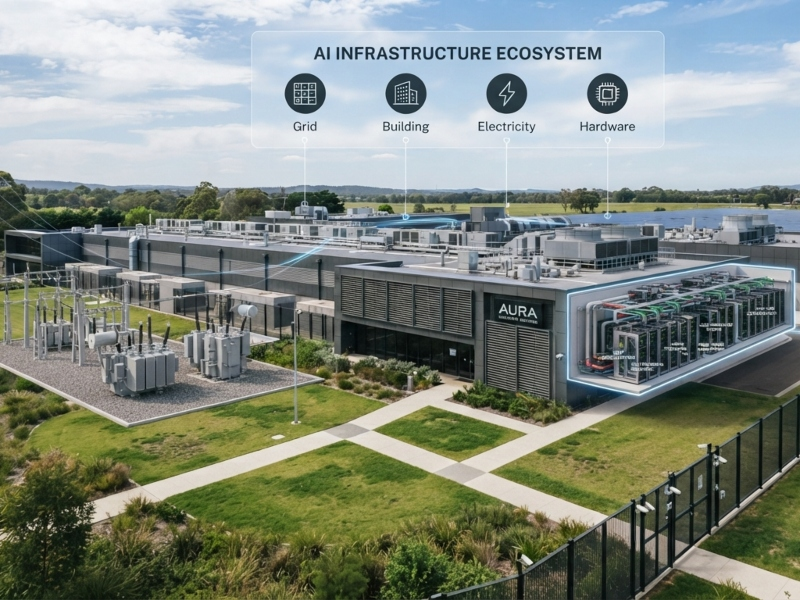
AI is Becoming an Infrastructure Business
The biggest change in artificial intelligence may no longer be happening inside software. It is happening in data centers, semiconductor factories, power grids and cooling systems.
For years, the AI boom was mainly associated with companies developing models, applications and AI agents. But as AI use expands, the industry is becoming increasingly dependent on physical infrastructure. Chips must be manufactured, data centers must be built, electricity must be secured and increasingly sophisticated cooling systems must keep densely packed servers operating.
This is creating a new business opportunity well beyond AI software.
The scale of the investment is already substantial. IDC estimates that worldwide spending on AI infrastructure reached $318 billion in 2025 and forecasts about $487 billion in 2026. IDC expects the market to exceed $1 trillion annually by 2029.
Alibaba provided one of the clearest recent examples of where the industry is heading. At its September 2026 Apsara Conference, the Chinese technology group introduced its Zhenwu V900 AI chip and said Alibaba Cloud plans to increase its globally operated data-center capacity to more than 20 gigawatts by 2032. The V900 is expected to enter mass production in early 2027.
The significance goes beyond one company’s chip. Alibaba is developing models, processors and cloud infrastructure as parts of the same system. The company has already committed 380 billion yuan, about $53 billion, to AI and cloud infrastructure over three years, with spending accelerating in 2026.
China is pursuing a broader industrial strategy as well. In September, China’s Ministry of Industry and Information Technology and National Development and Reform Commission released a 2026 to 2030 plan for electronic information manufacturing. It targets more than 30 trillion yuan in annual revenue for qualifying companies by 2030 and specifically identifies integrated circuits, advanced computing, consumer electronics, electronic components and energy electronics as priority areas.
That matters because AI requires a much larger industrial ecosystem than a powerful processor. Semiconductor manufacturing depends on equipment, advanced packaging, memory, circuit boards, connectors, electronic materials, testing and precision components. China’s plan specifically calls for progress across these parts of the supply chain.
Energy is another constraint.
The International Energy Agency estimates that data centers consumed about 485 terawatt-hours of electricity in 2025 and projects that consumption to reach about 950 TWh by 2030. Electricity use by AI-focused data centers is growing even faster than overall data-center consumption.
This changes the business equation. A company planning an AI data center cannot simply buy servers and find a building. It needs reliable electricity, grid connections, transformers, backup power, cooling, networking and suitable land. These requirements are creating opportunities for companies that traditionally had little connection with the technology industry.
Malaysia provides a useful example. Tenaga Nasional has said it is supporting 49 data-center projects representing about 7.1 GW of demand. That scale of demand requires substantial investment in generation and grid infrastructure.
For businesses, the opportunity therefore extends across several layers. Semiconductor companies can benefit from the demand for processors, memory and advanced packaging. Electrical equipment manufacturers can supply transformers, switchgear and power-management systems. Engineering companies can work on data center construction and cooling. Renewable-energy developers can provide additional power, while logistics and industrial-property companies can support the expanding physical infrastructure.
There is also an opportunity for small businesses. Data centers require maintenance, security, specialized cabling, cooling equipment, monitoring systems, spare parts and technical services. As more facilities are built across Asia and the Middle East, local suppliers may find opportunities without having to compete directly with the world’s largest technology companies.
Good examples of companies and technologies to watch include Nvidia’s AI accelerators, AMD’s Instinct processors, Huawei’s Ascend platform and Alibaba’s Zhenwu chips. In cooling, liquid-cooled systems are becoming increasingly relevant as AI servers generate much more heat than conventional computing equipment.
The infrastructure boom does carry risks. Large data centers can place pressure on electricity and water resources, while projects can face long waits for grid connections, equipment and construction. In the United States, for example, Texas recently paused new state-issued data-center permits while authorities examine their effect on the electricity grid.
For entrepreneurs and investors, the lesson is straightforward. The AI market should not be viewed only through companies developing the next model or chatbot. Much of the spending is moving into the physical systems that allow those models to operate.
The next generation of AI businesses will therefore involve much more than software engineers. It will require chip manufacturers, electrical contractors, energy companies, cooling specialists, construction firms, equipment suppliers, data-center operators and a long list of businesses supporting them.
AI may have started as a software story. Increasingly, it is becoming an infrastructure story built with silicon, steel, electricity and concrete.